Projekt eTwinning „FUN-tastic Local Traditions”
Projekt eTwinning „FUN-tastic Local Traditions”
Harmonogram działań:
- Marzec – nasza szkoła, nasze miasto
- Kwiecień, maj – tradycje lokalne i narodowe
Działania w marcu i kwietniu.
Szkoły, które biorą udział w projekcie:
| l.p. | Nazwa szkoły | Kraj |
| 1 | Cumhuriyet Primary School, Turkey | Turcja |
| 2 | Bonvesin de la Riva Secondary School in Legnano | Włochy |
| 3 | Don Milani Primary School | Włochy |
| 4 | Colégio Laura Vicunha, Vendas | Portugalia |
| 5 | Liceul Tehnologic Anghel Saligny Turț | Rumunia |
| 6 | Szkoła Podstawowa nr 7 w Białymstoku | Polska |
Oto informacje, które udało się zebrać od naszych partnerów projektu:
| Nasza szkoła | |
| Turcja | Link do strony szkoły TUTAJ |
| Włochy | Film o szkole Bonvesin de la Riva Secondary School - Legnano |
|
Film o szkole Don Milani Primary School TUTAJ |
|
| Portugalia |
Film o szkole Colégio Laura Vicunha, Vendas |
| Rumunia |
Film o szkole Liceul Tehnologic Anghel Saligny Turt |
| Nasze miasto: | |
| Adana, Turkey |
We will inform you about the city of Adana which is a Turkish city in the Mediterranean Region.Please enjoy while you are reading! Adana is one of the biggest cities in terms of its population; This city’s population is 2.262.226. There are 15 districts in total and 5 of them are located in the city center. Adana has a big civilisation and a great history which goes to B.C 3000. Through the history, in the lands of Adana there were big civilisations such as Rome, Byzantine, Asyria, Persian, Alexander the Great, Mameluke, Seljuq Empire. Adana is a beautiful touristic city as you see and you need to know that if you come to Turkey, Adana should be a city you need to see before leave! Film o mieście: |
| Legnano, Italian |
Legnano is an Italian town situated in the north-west of the Province of Milan. It is crossed by the Olona river and the town was established in 1261. After the historic victory of the Lombard League over Frederick Barbarossa at Legnano, it is the only town other than Rome named in the Italian national anthem. Every year the people of Legnano commemorate the battle with Palio di Legnano, on 29 May, the day of the battle of Legnano. The city was the protagonist of a progressive urbanization in the 20th century and this attracted workers from different parts of Italy. In Legnano there is a historical subdivision into neighborhoods, for example Mazzafame, Ponzella, Frati, Olmina, Legnanello. The eight historical contrade competing at the Palio di Legnano are San Bernardino, La Flora, Legnarello, San Domenico, San Magno, San Martino, Sant'Ambrogio and Sant'Erasmo. Film o mieście: Wirtualna wycieczka po mieście - tutaj |
| Vendas Novas, Portugal |
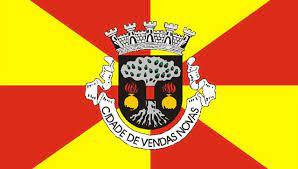
Once upon a time there was a princess…in South Portugal, Évora district: the city of Vendas Novas.
|
| Turt, Romania |
Turț is an old settlement in north-western Romania, being inhabited since prehistoric times. The first documentary record of the locality is dated to 1378. This settlement is one in which the main concerns of the people were: agriculture, crafts, animal husbandry and mining. It is an area where many traditions and customs are preserved. People are hardworking, kind and welcoming. Unfortunately after 1990 many inhabitants went to work abroad. If you come to Turț you can see people in popular clothes especially on Sundays at church and holidays, old customs preserved for hundreds of years, as well as tasting an alcoholic beverage specific to the area, named pălincă. |
| Propozycja logo: | |
| Turcja |  |
| Rumunia |  |
| Polska |  |
| Polska |  |
| Włochy |  |
| Włochy |  |
| Włochy |  |
| Portugalia |  |
| Plakat projektu: |
|
| Turcja |  |
| Rumunia | 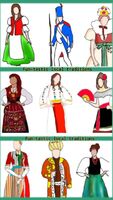 |
| Polska |  |
| Włochy |  |
| Włochy | 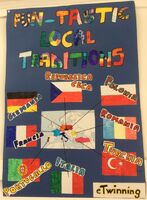 |
| Włochy |  |
| Włochy |  |
Działania w maju.
| Nasze lokalne tradycje: | |
| Rumunia |
Wedding in Turț, by students and Nemet Stelian In Turț, the wedding has many traditions preserved for decades. Film: |
| Rumunia |
Easter traditions Turț, Romania. In the Great Week before Easter, the people of Turț have several traditions: Film: |
| Polska |
Wielkanoc w Polsce Link do prezentacji tutaj |
| Polska |
Karnawał w Polsce Link do filmu tutaj |
| Polska |
Podlaskie stroje ludowe Młodsze klasy naszej szkoły przygotowały ciekawe wariacje artystyczne ludowych podlaskich strojów. Dzieci odwzorowały klasyczne wzory ludowe naszego regionu Podlasia ale również dodały od siebie nutę swojej wyobraźni. W sumie dało to ciekawe połączenie tradycji z nowoczesnością. Pobudziło to w uczniach ich artystyczną kreatywność i chęć projektowania nowych wzorów w połączeniu z tradycyjnymi.
|

| Nasze ogólnopaństwowe tradycje: | |
| Rumunia |
Sâmbra Oilor, from Liceul Tehnologic Anghel Saligny Turț. Oaș Country is one of the few ethno-folkloric areas in Romania that keeps its identity features unaltered. The village of Turț is also part of the Oaș Country, so people from the locality participate in Sâmbra Oilor every year. Sâmbra Oilor Festival is the largest festival in Oaș Country, taking place every year, in May, on the hill from Huta-Certeze. The sheep's saturday is celebrated through music and dances in folk costumes, it takes place at the Broken of the Barren, that is, the separation and counting of sheep as well as the measurement of milk by shepherds. Film: |
| Polska |
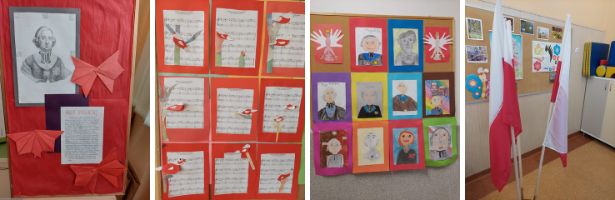
Święto Narodowe Trzeciego Maja Film: |
| Polska |
Hugo Kołłątaj - Patron Szkoły Podstawowej nr 7 w Białymstoku Hugo Kołłątaj, (1 April 1750 – 28 February 1812), was a prominent Polish constitutional reformer and educationalist, and one of the most prominent figures of the Polish Enlightenment. He served as Deputy Chancellor of the Crown, 1791–92. He was a Roman Catholic priest, social and political activist, political thinker, historian, philosopher, and polymath. Hugo Kołłątaj is our School Patron.
|